



Take a product specification marked “UPF50+” as an example. The buyer still needs to identify what was tested and which specimen was used, then check whether it matches the version being ordered. If light blocking, heat shielding or sun and rain use are also required, review the results for each property. Clear requirements help you compare suppliers’ documents and decide what to check during sampling.
1. What UV protection, light blocking and heat shielding tell you
UPF and UV blocking rate
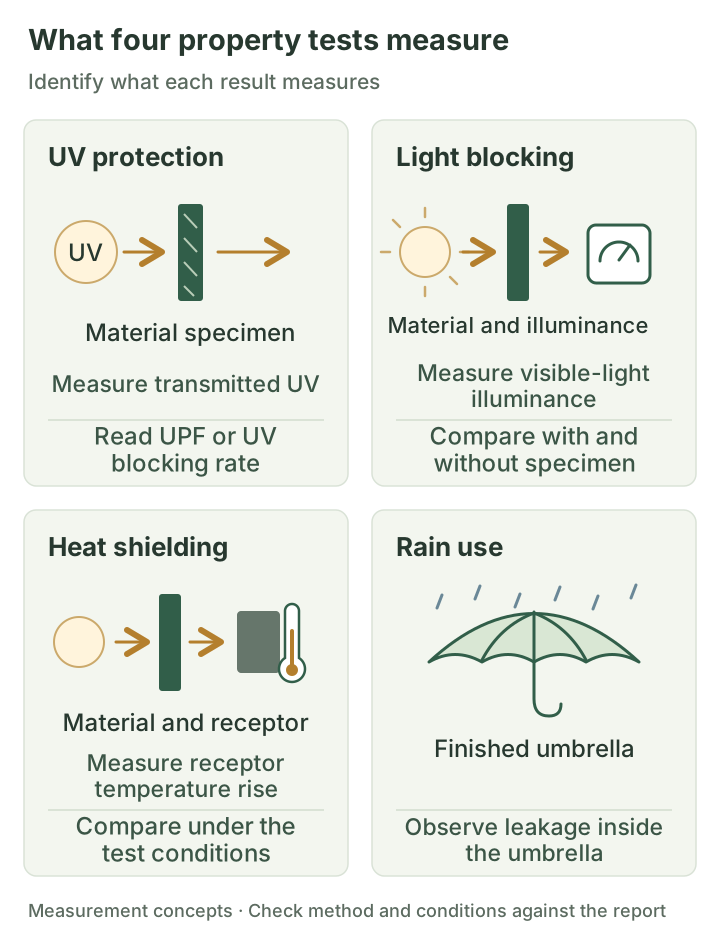
UV blocking rate expresses the percentage of ultraviolet radiation blocked by the tested material under the method used. UPF is calculated from UV transmittance, with weighting for factors such as solar radiation and biological response at different wavelengths. The two indicators have distinct definitions and ways of expressing results. Record the indicator name, test method and result separately in the purchasing specification.[1]
Check whether the report describes a fabric specimen, a material combination or a particular area of the finished product. A fabric-specimen result shows how that material performed under the stated test conditions. The complete umbrella’s structure, seams, coverage and holding position need their own documentation and checks.
Light blocking rate
A light-blocking test evaluates how much illuminance changes when light passes through the material. The public explanation of JIS L 1055 Method A, for example, describes using an illuminance meter to measure before and after a specimen is placed in position, then calculating the light blocking rate. JUPA refers to this method in its industry evaluation of umbrella fabrics. Read the value alongside the method, illuminance conditions and specimen tested.[2] [4]
If the purchase requires both UV protection and light blocking, list the two results separately. Record the sample’s colour, inner and outer layers and treatments so that the material combination covered by the report can be checked.
Radiant heat shielding and perceived coolness
The JIS L 1951 heat-shielding test exposes material to an artificial sunlight source. It compares the temperature rise of an irradiated receptor with and without a specimen, then calculates the heat shielding rate and corresponding classification. The result describes the material’s shielding of radiant heat in the specified apparatus and conditions.[3]
Air temperature beneath an umbrella, surface temperature and a person’s thermal sensation are different things to measure. A claim that an umbrella “reduces temperature by a certain number of degrees”, or feels cooler than another product, needs a separate test of the complete umbrella. Specify the test environment, what is used for comparison, the measurement points and how the test is repeated. BOKEN’s public explanation also distinguishes fabric tests from product tests whose conditions are agreed separately.[5]
| Property to confirm | What the documentation should show | How to use it in procurement |
|---|---|---|
| UV protection | Method, UPF or UV blocking rate, specimen identity and conditions | Check that the intended product claim matches the configuration actually tested |
| Light blocking | Light blocking rate, method, illuminance and material layers | Confirm the required light blocking performance and the combination covered by the report |
| Heat shielding | Heat-shielding test result, what was measured, apparatus and conditions | Interpret the result within the test performed; for whole-umbrella temperature differences, check the corresponding comparison records |
| Rain use | Fabric water repellency and resistance to water penetration, finished-umbrella leakage resistance, intended rain conditions and care instructions | Define the requirements and acceptance procedure for rain use of an umbrella intended for both sun and rain |
2. Relating canopy performance to actual use
Coverage and holding position
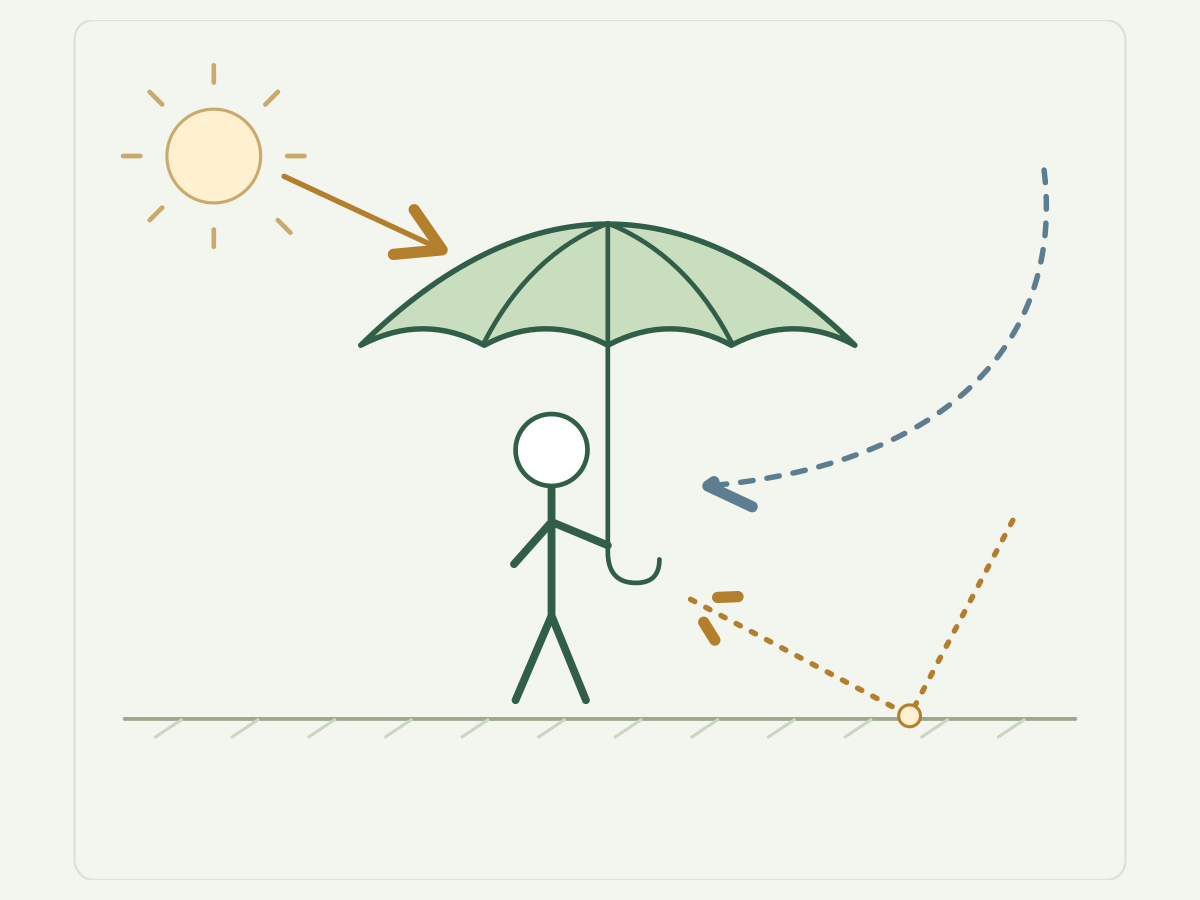
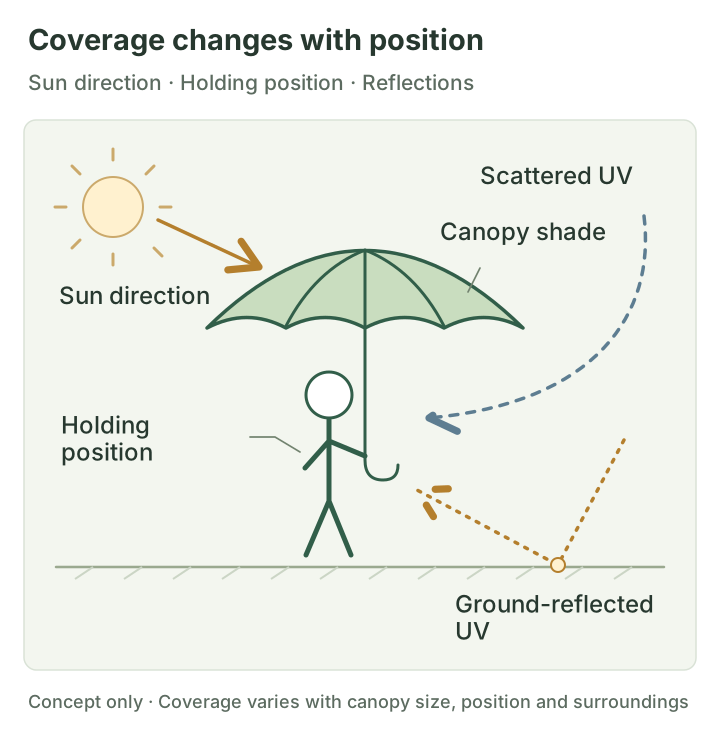
When choosing a portable UV-protective umbrella, consider its open coverage, holding position and surroundings as well as the material results. As the direction of the sun changes, so does the shade cast around the body. WHO’s guidance on shade warns that scattered and reflected UV can still reach people beneath umbrellas and other shade structures.[6]
Germany’s DGUV also lists canopy material, size, sun direction and angle among the factors for selecting workplace shade. Use these factors when planning checks of a handheld model. Check coverage using its actual open dimensions and holding positions, and record whether it is intended for one or more users, how it will be carried and its main uses.[7]
An umbrella for sun and rain also needs rain-use specifications
Surface water repellency, fabric resistance to water penetration and leakage in the finished umbrella need separate checks. QTEC’s public explanation of leakage resistance describes observing the inside of a finished product after artificial rainfall, including its seams and joints. The page identifies the reference-method version; the conditions and requirements used must be confirmed for each project.[8]
For sun umbrellas or dual-use umbrellas offered in Japan, UV protection, light blocking, heat shielding and rain requirements can be specified separately. JUPA’s industry rules list these test categories individually. Check local use descriptions against the particular product information and intended rain use, including which function is primary.[4]
Buyer and supplier should document the expected rain conditions, inspection method and care requirements. A product focused on everyday shade and portability may need different materials, construction or acceptance checks from one intended for frequent rain use. Discuss these trade-offs when selecting the model and approving samples.
3. Matching test reports to the product you are buying
When a report arrives, identify the tested sample’s material, colour and condition before deciding whether its results apply to the order. Ask the supplier or report issuer to clarify any fields that need further explanation.
Check the document and specimen identity
Record the issuing organisation, report number and date, retain every page, and verify the document using the organisation’s stated procedure. Then check the specimen code, name, material and colour against the order specification. If the supplier uses internal fabric or sample codes, explain them in the specification so that both parties know which material or sample is meant.
Check the method and its scope
Look beyond a standard’s title to its intended application. The public preview of EN 13758-1:2001+A1:2006, for example, covers clothing textiles. That version excludes shading materials held at a distance from the skin, such as umbrella fabric. If a material report uses this method, ask the issuer to explain its assessment of suitability for the intended umbrella use and the basis for the proposed product claims.[9]
Other methods and schemes have different scopes. UV STANDARD 801 has a shading-materials programme that tests new, stretched, wet and weathered material and takes the lowest value measured under that programme as the final material result. Australia’s ARPANSA shade-fabric service provides UVE results under AS 4174. When comparing documentation, retain each method’s name, scope and form of result.[10] [11]
Check the condition, result and proposed claim
A report may test new fabric or include wetting, stretching, ageing or other pre-treatment. Record the tested condition, then read the units, classifications and qualifications attached to each result. Values obtained in different conditions or under different programmes should be considered separately.
If you intend to make a claim about material performance after use, obtain evidence for that condition. If you also plan to use a certification mark, check the valid certificate, the materials or products and colours it covers, and the rules for using the mark. Confirm that they apply to the version being purchased.
| Report check | Information to record or confirm |
|---|---|
| Document identity | Issuer, report number, date, complete pages and verification procedure |
| Method | Name, version, applicable products and any stated departures from the method |
| Object tested | Fabric specimen, material combination, finished product or tested area |
| Configuration | How the sample code relates to the purchased model, fabric, colour, coating and print |
| Conditions | Dry or wet state, stretching, ageing and any other pre-treatment actually used |
| Use of the result | Proposed value, classification or certification claim, together with the supporting report and scope |
4. Setting specifications for the intended use
Once the performance requirements are set, choose the construction and dimensions around how the umbrella will be used. For everyday commuting, consider which bag it needs to fit, its closed length and ease of opening and closing. For brand events and outdoor use, define the number of users, coverage needed and carrying arrangements. Where rain use is intended, include the rain conditions and relevant acceptance checks in the same specification.
| Main use | Priority checks | Factors to balance |
|---|---|---|
| Everyday carry and retail | Open coverage, closed length, weight, opening and closing mechanism, and sleeve | Portability, packed size, user habits and required coverage |
| Branded gifts and events | Fabric, base colour, inner and outer print, logo position, packaging and performance requirements | Print appearance, full product specification, sample appearance and purchasing budget |
| Sun and rain use | UV and other performance requirements, finished-umbrella rain performance, construction and care instructions | Portability needs, frequency of use and agreed rain conditions |
When comparing dimensions, state what has been measured. Rib length, canopy arc length, open diameter and closed length describe different measurements. Use clear, consistent names in quotations. The existing size guide can help check the measurement methods. CITTA umbrella size guide
190T and 260T are common density designations for woven umbrella fabrics; black coating describes a fabric treatment. The purchase order should also specify fibre composition, colour and print. Check that the test documentation covers the version being ordered. The fabric guide explains these material specifications in more detail. CITTA umbrella fabric specification guide
5. Checking specifications with CITTA product examples
The public product page for SUN-21876 lists a two-fold construction, 8 ribs and manual opening. FOLDING-36194 is listed as three-fold, with 6 ribs and manual opening.[12] [13] CITTA has also supplied details of the fabric, coating, print and intended use of both models. The table brings these details together so you can compare folding format, materials and storage needs.
| Item to check | SUN-21876 | FOLDING-36194 |
|---|---|---|
| Original “Canopy size” label | 19inch | 19 inch |
| Construction and opening | Two-fold, 8 ribs, manual opening | Three-fold, 6 ribs, manual opening |
| Fabric designation | 190T black-coated fabric, supplier designation “全遮” | 30D black-coated fabric with digital inkjet printing |
| Colour or pattern | Patterned | Digital inkjet pattern |
| Coating | Black coating | Black coating |
| Print configuration | Digital inkjet pattern | Digital inkjet printing |
| Intended use | Sun and rain, primarily for shade | Sun and rain, primarily for shade |
| Storage care | Allow to dry after use before storing | Allow to dry after use before storing |
In these examples, the 19-inch measurement runs along the curved canopy surface from its apex to one edge. Record open diameter, closed length and weight separately so you can compare coverage and portability. Once the fabric has been selected, check that the actual test specimen has the colour, coating and print being ordered. Confirm each required UV, light-blocking, heat-shielding or rain property using the corresponding result.
FOLDING-36194 also comes with a crossbody bag. When checking the sample, inspect the umbrella and bag together: their appearance, how they are supplied as a set and how the umbrella is stored. For both models, allow the umbrella to dry after use before storing it, as the care instructions require.
Photographs of the two models
SUN-21876 · Two-fold, manually opened model
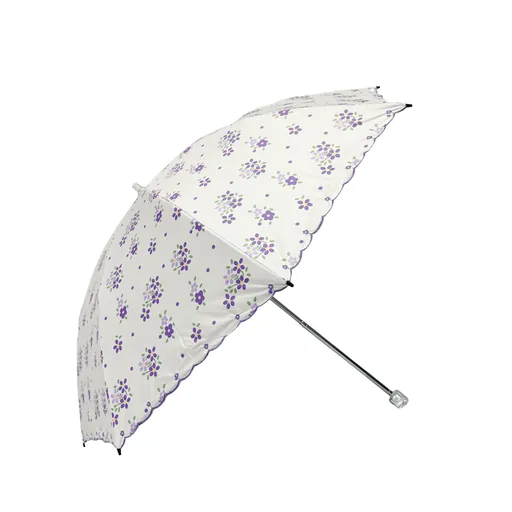
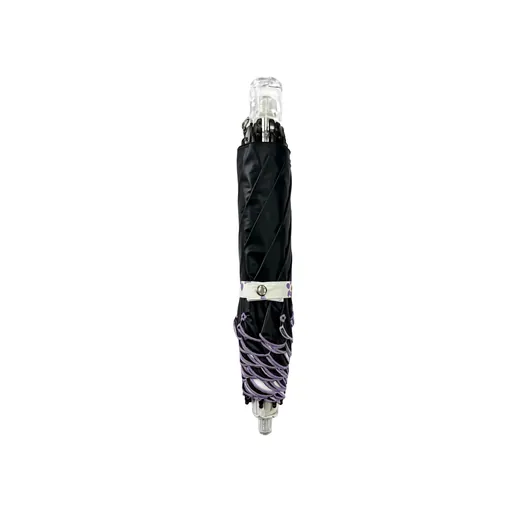
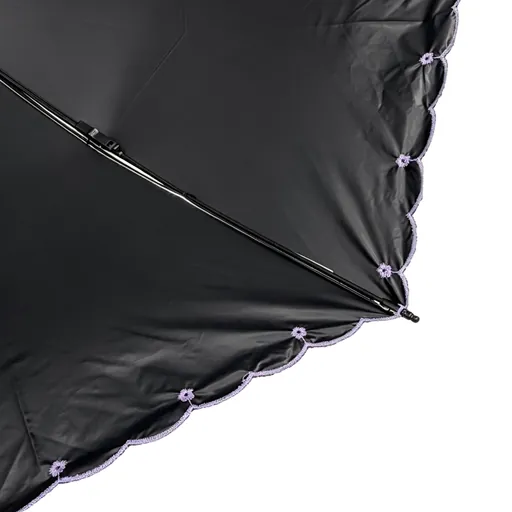
Figure 3a · Photographs from the current online product gallery, each shown in its original orientation. Source: SUN-21876 product gallery.
FOLDING-36194 · Three-fold, manually opened model and crossbody bag
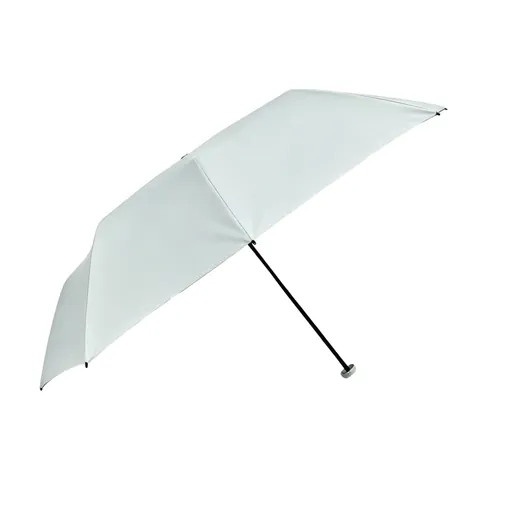
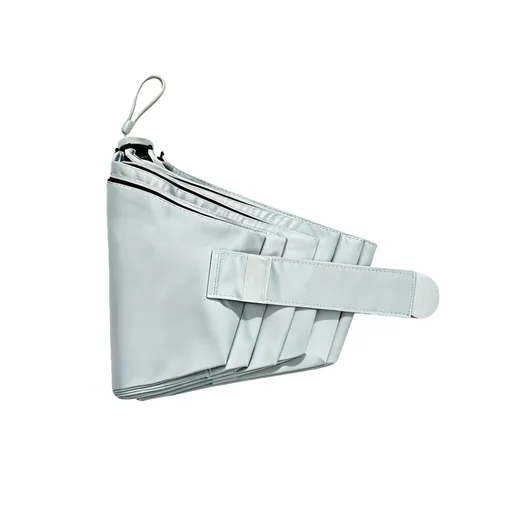
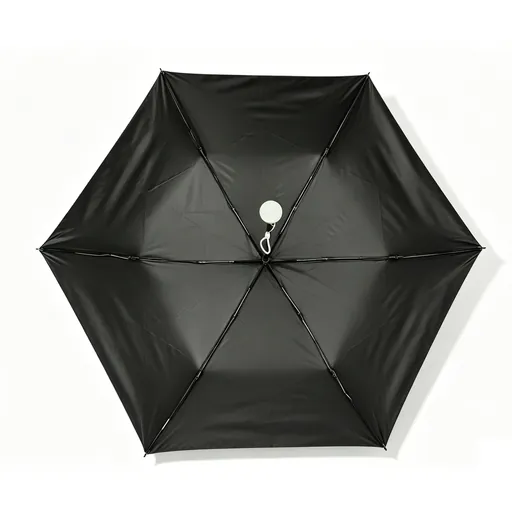
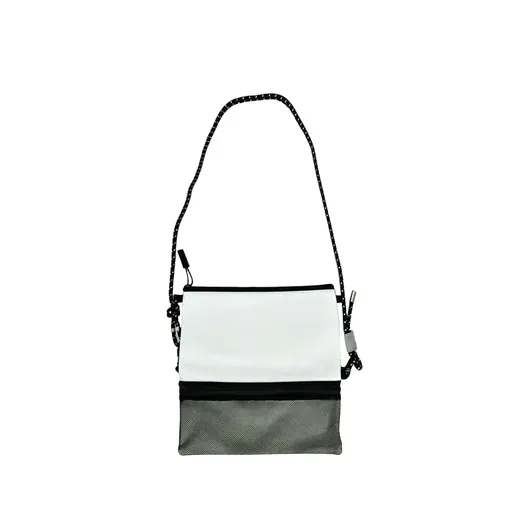
Figure 3b · Photographs from the current online product gallery. Source: FOLDING-36194 product gallery.
Each state was photographed separately, and the images are scaled independently for the layout. Confirm actual size from product specifications and measurement records.
Record the base model and order configuration separately
CITTA’s published fabric guide distinguishes the catalogue version of GOLF-48271 from the version used in a 16,000-unit order. The catalogue lists 260T, while the documented order used 210T fabric with black coating and digital printing. Record the material used for each order separately, even when the base model is unchanged.[14]
For UV-protective umbrellas, use the model code to identify the product and the order specification to state the fabric, colour and processes. Link the relevant reports and approved-sample records to that particular version.
6. Customisation changes and sample approval
Colour, coating, artwork or material may change between the enquiry and sampling stages. Buyer and supplier should record the revised fabric, colour, coating and artwork in the same version of the specification, then use that version to make and check samples.
Record what has changed
A change record should identify both the previous and new configurations. It can list the fabric code, base colour, coating or layers, printing method, artwork version and areas changed. Where panels, decorations or different material zones are involved, identify each area’s location and material in the sample description or an annotated drawing.
Confirm whether the original report covers the new configuration
If the specification changes, ask the supplier and report issuer which original results still apply and which properties need further evaluation. They should consider the specific change, the original test method and what was tested. Record their conclusion in the specification.
For print approval, check colour on the actual fabric, design coverage, seams and the orientation of the design. See the printing guide for the processes and artwork checks. CITTA umbrella printing guide
State exactly what the sample approval covers
Record appearance, dimensions, construction, opening and closing, and performance evidence as separate items. If the pattern position and colour have been approved, record that approval. For each performance item, identify the report and specimen relied on. Later inspections can then refer to the record for each approved item.
The record should also include the sample number, corresponding artwork and material versions, approval date and production checks agreed by buyer and supplier. Where dimensional tolerances, sampling or other decision criteria are agreed, document both the method and the requirements.
7. Pre-order procurement checklist
Use this table to organise enquiry and sample-approval information. Complete the performance items according to the intended sales claims and actual use. If a requirement is still undecided, note where you need the supplier’s advice on selection.
| Item to confirm | Information to include |
|---|---|
| Target market and use | Country of sale, users and main uses; everyday shade, sun and rain use, or other requirements |
| Model and order version | Base model, order-specific construction and opening mechanism, specification version |
| Dimensions and weight | Open dimensions, rib or arc length, closed length, weight and the measurement basis for each |
| Materials and appearance | Fabric code, colour, coating, layers, print and artwork version |
| Performance requirements | Required UV, light-blocking, heat-shielding or rain properties; target result, test object and conditions |
| Reports and other evidence | Issuer, report number, method version, specimen identity, results and configuration covered |
| Sample approval | Sample number, approved appearance and dimensions, performance documentation and agreed differences |
| Labelling, artwork and packaging | Performance claims, languages, logo position, label content and packaging requirements |
| Production and delivery | Quantity, target delivery arrangements, production checks and agreed acceptance conditions |
When discussing a project with CITTA, provide the target market, intended use, estimated quantity, style and any existing specifications. Use these details to discuss materials, customisation and sample arrangements for your project.
Discuss a custom umbrella project with CITTA · Read about quality control
References
Technical and standards information was checked on 10 November 2026. Product fields for SUN-21876 and FOLDING-36194 were rechecked on 11 November 2026. The procurement checks are this article’s recommendations based on method scope and specification-review needs. Testing organisations’ explanations, regional industry rules and individual product details are each used within their respective scope.
- QTEC · UV shielding, JIS L 1925
QTEC’s public explanation of UV blocking rate, UPF calculation and fabric-specimen testing under JIS L 1925. This article refers to that public explanation, rather than the full standard text.
- KAKEN · Light-blocking test, JIS L 1055
Originally an explanation of curtain light-blocking tests. Read its use for umbrella fabrics alongside JUPA’s rules.
- KAKEN · Heat-shielding test, JIS L 1951
Explains the material, irradiated receptor’s temperature rise, heat shielding rate and test conditions.
- JUPA · Detailed industry criteria
The Japanese industry association’s rules list UV, light-blocking, heat-shielding, water-resistance and finished-product leakage tests separately. Check mark-use and claim rules within that scheme’s scope.
- BOKEN · Heat-shielding tests and product-test conditions
Explains the distinction between material tests and product evaluations under separately agreed conditions.
- WHO · Radiation: Protecting against skin cancer
The “Use shade wisely” section explains scattered and reflected radiation beneath umbrellas and other shade structures.
- Germany’s DGUV · Non-ionising radiation FAQ, question 4
Guidance on materials, dimensions and angles for workplace parasols and awnings. This article uses its general selection considerations; individual handheld models need assessment under actual conditions of use.
- QTEC · Finished-product leakage-resistance test
The public page cites JIS S 4020:1994. Confirm the method version, conditions and requirements adopted for the actual order.
- SIST · Public preview of EN 13758-1, page 5
The European text viewed is EN 13758-1:2001+A1:2006; the SIST implementation is 2002+A1:2007. This article cites that preview’s Scope. Check the version actually used in each report.
- UV STANDARD 801 · Shading-materials test programme
Explains new, stretched, wet and weathered conditions, and how the final material result is selected.
- ARPANSA · Shade fabric testing
The Australian shade-materials service uses AS 4174 and UVE evaluation. ARPANSA also explains the exclusion of off-body shade uses under AS/NZS 4399:2020. The article uses this as a regional method example.
- CITTA · SUN-21876 product details
Model, original “19inch” label, construction, fabric and handle fields.
- CITTA · FOLDING-36194 product details
Model, original “19 inch” label, three-fold construction with 6 ribs and manual opening, 30D black-coated digital inkjet fabric described as ultralight, and handle details.
- CITTA · Umbrella fabric specification guide
How to read fabric specifications and distinguish the GOLF-48271 catalogue configuration from the documented order configuration.